ByramADVISORY GROUP Book a Teardown

The Sprint · self-guided · built by your firm

Build the finance and accounting platform your firm needs.

The Sprint is a self-guided finance and accounting platform your firm builds for itself. You choose the workflows and make the accounting decisions.

$2,000 once per firm. No seat limits. A perpetual licence to the supplied source code.

Workspace subscriptions, AI usage and hosting are separate costs.

For accounting and CAS firm owners. The free teardown is twenty minutes, with no system access or installation required.

01A platform built around your firm

Your decisions become the plan.

Your firm has its own way of reviewing work, approving entries and serving clients. The Sprint helps you turn those decisions into a platform you can run, change and expand on your own systems.

The plan can cover the close, forecasting, valuation and reporting. You choose the work your firm needs; the catalog records which parts are implemented, scaffolded or still planned. Your firm builds and validates the selected workflows before live use.

The Sprint gives you a guided plan, tested starter code and controls for approvals, duplicate actions and AI spending. Your own compatible AI coding workspace helps carry out the build.

You receive the foundation and the build process. Your working platform takes shape as you implement and test the workflows your firm needs.

Start with one useful workflow. Give your coding workspace the plan and the supplied source. Build and test the workflow with made-up data, then prove the integrations and controls it needs before approving live use.

02What your purchase includes

The foundation and a process for building on it.

A guided planner

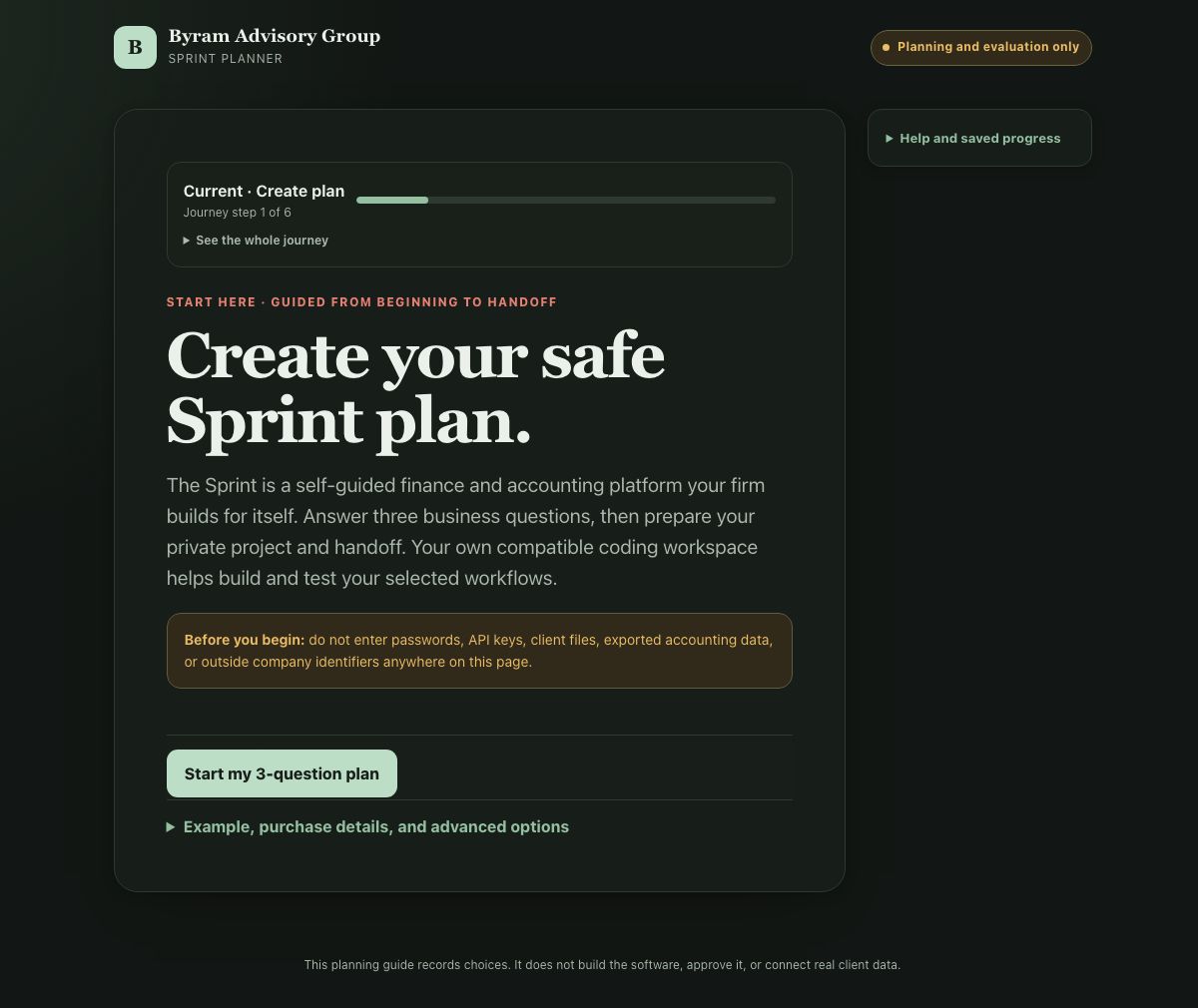
Open one local browser file and answer three Quick Start questions: your work type, the first accounting product to prove and the first useful result. An optional seven-stage Customize path records more detailed requirements.

Tested starter source code

The package includes the control plane, accounting calculation engines, project rules and worked examples. Inspect, run and modify the source under your firm’s perpetual licence.

A plan for your coding workspace

The planner produces a written record of your decisions and a structured handoff. One persistent Sprint Workspace carries those decisions through implementation, testing and later changes.

Setup and build guides

Plain-language instructions cover the private repository, workspace handoff, ledger credentials, hosting, customization and the checks required before live use.

A catalog of workflows to build

Each part has a recorded status and dependencies so you can distinguish the tested foundation from work that still needs implementation.

Screenshot of the supplied Sprint planner welcome screen, with a three-question plan and a planning-only notice.
Screenshot of the supplied Sprint planner. It records your choices; your firm still builds and validates the workflows.

232 files plus a release manifest. Four worked examples. Five checks. 2,140 tests passed; 1 skipped. These tests cover the supplied components. Each workflow and integration your firm builds needs its own validation.

03See an accounting example

Follow a proposal through approval and posting.

The included lease example shows the ASC 842 calculation engine moving a proposed journal through the control plane to a single posting. A separate control demonstration uses a throwaway database and a fake ledger to show how approval and retry protections work.

  1. A request to execute without approval is refused.
  2. A service account’s attempt to approve is refused.
  3. A named person approves the proposal, and the entry posts once.
  4. A retry returns the existing result without another posting.
  5. A request with changed figures is refused because it no longer matches the approved proposal.

Three unsafe requests are refused. One entry posts. The retry returns its original result.

04Controls for the workflows you build

Make approval part of the workflow.

The supplied control plane provides one guarded path for actions. Your finished build must connect every relevant action to that path and prove that it works.

Human approval
A guarded ledger change starts as a proposal. A named person must approve it before execution. A service account cannot approve it.
Approval tied to the proposal
Approval applies to the exact proposal reviewed. Changing its contents invalidates that approval.
Duplicate action protection
The control records action identities and returns the recorded result for a completed action. Each live integration must also prove its handling of timeouts and retries.
AI spending controls
The control reserves budget before a call and records the actual cost afterward. You set the spending ceiling for the configured period. Limits by engagement require implementation and testing.

Your firm owns the review.

These controls support a reviewable process. Your firm still assesses the accounting, reviews model output and configures permissions in the ledger and other connected systems. Direct access and paths outside the control plane need their own restrictions.

Your firm’s written AI policy, client consent requirements and professional obligations remain your responsibility. The Sprint supplies software controls and build guides to support your process.

05How your firm builds it

Choose a result. Build it. Prove it.

  1. Choose the first useful result

    Download the package and open 0-START-HERE.html in your browser. Use Quick Start or Customize, then review your plan in plain language.

    The planner runs locally, requires no sign-in and sends none of your entries off your machine. The handoff you later share follows your coding workspace provider’s data path.

  2. Prepare one private workspace

    The Setup Cockpit and README.md walk you through a private repository, the applicable disposable hosting probe and one persistent Sprint Workspace. GitHub Desktop handles identity settings, the first commit and private publication through buttons.

    Use your own ChatGPT Work local project with Work locally selected, or a Claude Cowork task with the permanent repository folder selected. Availability depends on the app, plan, settings and permissions. Neither service is included.

  3. Hand over the plan and authorize the build

    The planner creates BAG-build-handoff.zip with four files containing your profile, build brief, decisions and workspace start message. Attach it to the same Sprint Workspace.

    The workspace checks that the handoff is valid. Your build request, or an existing approval covering the same outcome and limits, supplies permission to implement it.

  4. Build and test the workflow

    Within the scope you authorize, the workspace carries out routine design, coding, testing, fixes and commits. It pauses for an uncertain fact, an action only you can take or a new material boundary. Deployment requires your approval.

    Repository rules instruct compatible workspaces how to follow your plan; the checker validates the handoff. Access permissions and runtime controls enforce separate limits on connected systems.

  5. Prove it before live use

    Start with made-up data. Build and validate the integrations, model calls, interfaces and sign-in your chosen workflow needs. Your firm reviews the evidence and approves the intended live use.

    Guarded ledger changes still require a named person’s approval of the exact proposal. Access to your books, data and paid AI accounts requires your permission.

Your first setup milestone: a private project, a reviewed plan and a validated handoff. The time and cost of reaching a working workflow depend on its scope, integrations and your chosen workspace.

Keep the same private repository and Sprint Workspace as you expand. Record changes to your decisions so the next build starts from the rules your firm already set. Keep credentials, client records and accounting-company identifiers out of the handoff and conversation.

06Understand what is built today

A tested foundation and a catalog of work to build.

The current catalog covers 157 parts across 23 families. Each part has its status recorded in the code and explained in MODULE-MAP.md.

Current implementation status of the Sprint catalog
StatusCountWhat it means for your build
Implemented16Built and tested components provide a starting foundation. Connections to your systems and your intended use still need proof.
Scaffolded9The structure is present; implementation and validation remain.
Planned132Requirements and dependencies are recorded for work still to build.

Accounting foundations and remaining work

The tested accounting foundations include ASC 842 lease calculations and the standard monthly journal, ASC 606 revenue calculations, and an ASC 205-40 indicator check. Related judgment, review, import, posting and reconciliation workflows have their own statuses and remaining work.

Most wider workflows—including document collection, contract reading, live financials, consolidation, reports, budgets and advisory—still need implementation. The 98 legacy assistant entries are an inventory to migrate, rather than working chatbot features. Live ledger links, model responses, chat screens and sign-in also need implementation and proof.

07Ownership and running costs

A perpetual licence. A system your firm runs.

Your firm receives a perpetual licence to use, run and modify the supplied source code. One purchase covers one firm and everyone in it, with no Byram subscription, seat limit or licence renewal.

Byram retains copyright in the original source. You own what you build on it, your data and your outputs, subject to the terms of sale.

The local base runs on your laptop. Hosted deployments and model connections use the accounts, credentials, spending limits and data paths your firm configures and approves. Your built system has no required Byram server or broker.

Workspace subscriptions, AI usage, hosting and any managed service you choose are separate running costs. Changing a ledger or model provider means building and validating the relevant integration.

08Choose how you want to build

Self-guided, or with time together.

For firms ready to lead their own build.

The Sprint

$2,000once per firm

One firm. No seat limits. A perpetual source licence.

The planner, starter source, controls, examples and reference guides give your firm the foundation and build process.

You choose the scope, follow the setup process and work in your own compatible coding workspace. Your firm owns testing, live-use decisions and ongoing operation.

Workspace subscriptions, AI usage and hosting are separate costs.

Get The Sprint — $2,000

Payment takes you to the download page, start guide and build reference. No Byram account or email wait is required. Read the terms of sale.

For firms that want to build with guided teaching.

The Bootcamp

$5,000per firm

Four live weeks. The Sprint is included in full.

Six reference chapters, a live session each week, a weekly office hour on your project and a group of other firm owners.

The learning outcome is one tested starter workflow on non-production data, a handover record and a plan for the next build.

The Bootcamp adds teaching and working time to the same Sprint package.

See the Bootcamp

Buy The Sprint first and its full $2,000 purchase price credits against one Bootcamp seat. The credit is single use and never expires. Credit terms.

What Sprint support covers

Product and planning support covers the planner, starter code, Sprint Workspace handoff and reference guides. You can email the closed, sanitized diagnostic supplied by the Setup Cockpit or Sprint Workspace.

Byram may clarify the next safe step as a courtesy; no response time is promised. Hands-on building, testing and refinement are outside this support.

09Start with your close

Choose a useful first workflow.

Accounting and CAS firm owners can book a free, 20-minute close teardown. We walk through one typical close and identify repeated work, approval points and a useful first workflow. Ask for a one-page map and we send it within 48 hours, with no purchase required.

Owen ran finance and accounting in private equity, then built a platform that connected the close with cash forecasting, valuation models and reporting. The Sprint brings tested forms of those controls into a package your firm can build on.

Read the case study →